
What to Expect During Your First Hearing Test at an Audiology Clinic in Brentwood TN

If you've been putting off a hearing test, you're not alone. Many people wait years before scheduling their first appointment — often because they're unsure what the process involves or whether their hearing loss is "bad enough" to warrant a visit. The reality is that a hearing evaluation is a straightforward, comfortable experience that gives you real answers about what's happening with your hearing. Here's exactly what you can expect when you come see us at our Brentwood, TN location.
Before You Arrive
No special preparation is needed before your hearing test. It helps to come ready to share a bit of your health history, including any medications you take, previous ear infections or injuries, noise exposure from work or hobbies, and any family history of hearing loss. If you've noticed specific situations where your hearing feels off — conversations in noisy restaurants, difficulty on the phone, or asking people to repeat themselves — make a mental note of those. That context helps us understand how your hearing affects your daily life, not just what the numbers say.
Step 1: Case History
Your appointment begins with a conversation. One of our audiologists will sit down with you and ask about your hearing concerns, your medical background, and your lifestyle. This isn't a formality — it genuinely shapes how we interpret your test results and what we recommend. Someone who plays in a band, works in construction, or has a history of ear infections may present very differently than someone whose hearing has simply changed with age.
We want to understand not just your hearing, but you — how you communicate, what listening situations matter most to you, and what's been frustrating you. That information becomes part of your care plan from day one.
Step 2: Physical Examination of the Ear
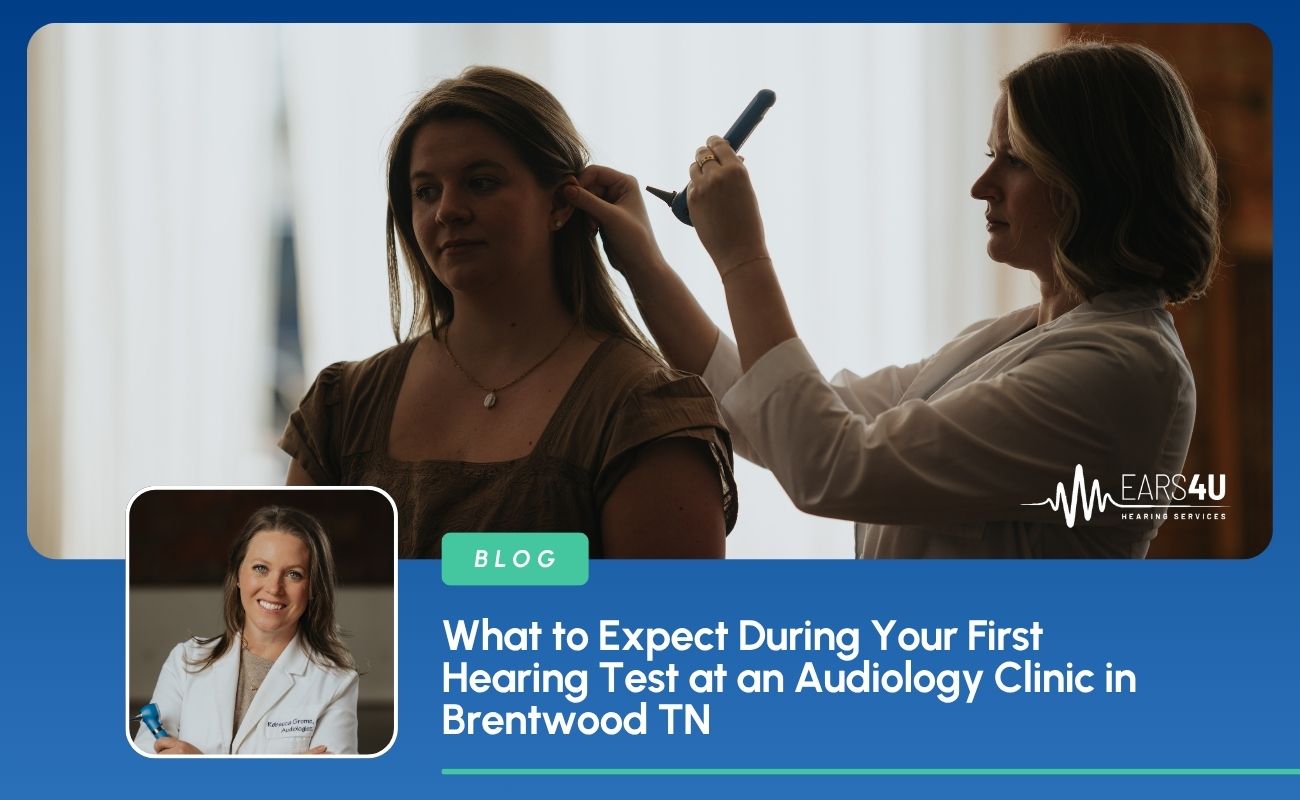
Before any testing begins, your audiologist will look inside your ear canals using a small handheld instrument called an otoscope. This quick, painless visual inspection checks for anything that might affect your hearing test results or your overall ear health — things like earwax buildup, signs of infection, or other physical changes in the ear canal or eardrum.
If significant earwax is present, it may need to be addressed before accurate testing can take place. We offer professional earwax removal at our Brentwood office, so that can often be handled at the same visit.
Step 3: Pure-Tone Audiometry
This is the core of a hearing evaluation. You'll be seated in a sound-treated booth and asked to wear a pair of headphones. Your audiologist will play a series of tones at different pitches (frequencies) and volumes through the headphones. Each time you hear a tone — even if it's very faint — you'll press a button or raise your hand.
The goal is to find the softest level at which you can detect sound at each frequency. These results are plotted on a chart called an audiogram, which gives us a precise picture of your hearing sensitivity across the full range of speech sounds and beyond.
We test each ear separately, so if there's a difference between your left and right ear, we'll catch it. In some cases, we'll also use a small device called a bone conductor, placed behind the ear, to determine whether any hearing loss is originating in the outer/middle ear or deeper in the inner ear. This helps us identify the type of hearing loss, which matters when considering treatment options.
Step 4: Speech Testing
Pure-tone testing tells us how soft a sound needs to be before you can hear it. Speech testing tells us something different — how clearly you understand words when you can hear them.
During this portion of the evaluation, you'll listen to a series of words spoken at a comfortable volume and repeat them back. We may also test how well you understand speech when there is background noise present. This is often where people notice the biggest disconnect — you can hear that someone is talking, but you can't make out what they're saying. That distinction is important for understanding the full impact of your hearing loss.
Step 5: Additional Testing When Needed
Depending on what we find during the evaluation, we may perform additional tests. Tympanometry is a common one — it measures how well your eardrum moves in response to changes in air pressure, which helps assess the health of your middle ear. This test is quick and completely comfortable.
If there are signs that tinnitus is a concern for you, that can also be assessed during your visit. We have dedicated providers here who focus specifically on tinnitus management, so if that's part of your picture, we'll make sure it's addressed.
Step 6: Reviewing Your Results
Once testing is complete, your audiologist will sit with you and go over your audiogram in plain language. You'll see your results mapped out visually, and we'll explain what they mean — including whether your hearing falls within normal limits, and if not, what degree and type of hearing loss is present.
This is also the time to ask questions. We believe patients who understand their hearing loss are better equipped to make decisions about their care. We'll cover what's likely contributing to your hearing changes, how your results compare to the range of normal, and what options are available to you.
If hearing aids are appropriate, we'll talk through what to look for given your specific hearing profile and lifestyle — not a one-size-fits-all recommendation. We work with several of the leading hearing aid manufacturers, which means our recommendations are based on what's right for your hearing, not limited to a single brand.
What the Results Won't Tell You
An audiogram is a powerful diagnostic tool, but it's a starting point, not the whole story. Two people with identical audiograms can have very different experiences with hearing loss. That's why the conversation that surrounds the test matters as much as the numbers themselves. Cognitive factors, communication habits, and the listening environments you're in most often all influence how we approach your care.
Schedule Your Hearing Test in Brentwood, TN
If you've been curious about your hearing — or someone close to you has suggested it's time to get it checked — there's no reason to wait. A hearing evaluation takes about an hour, is comfortable from start to finish, and gives you real information to act on.
Our Brentwood office is located at 1585 Mallory Lane, Suite 103, and we're open Monday through Thursday from 9am to 5pm, and Friday from 9am to 12pm. You can also reach us by phone or text at 615-205-7942.
We look forward to seeing you.